Business Automation · Healthcare
Surgery Connect Automation | Queensland Private Hospitals
· Autyra Team

Queensland’s Surgery Connect program is routing an increasing number of elective surgery patients from the public system to private hospitals. For facilities participating in the program, that means more patients, more referrals, more coordination, and more pressure on the administrative teams managing the workflow, from initial intake through to updating SCAN with clinical outcomes. Work that runs alongside the clinical work your staff is already doing.
The opportunity for automation isn’t about replacing how your team operates. It’s about removing the manual steps that sit between your systems. The re-keying, the chasing, the reformatting, so that information flows where it needs to go without someone having to move it by hand.
Here’s where that looks most practical.
How Surgery Connect Referrals Actually Work
When a public hospital identifies a patient suitable for Surgery Connect, the referral is sent via a secure clinical platform as a PDF. That document contains everything needed to begin the intake process: patient demographic information, confirmation of patient consent, clinical history, the GP referral, and any initial assessment results from the public hospital.
From there, the private hospital needs to do two things: update its Patient Administration System (PAS) with the patient’s information and forward the referral to the treating doctor’s rooms so the clinical team can review it and confirm acceptance.
Both steps currently require someone to manually read the document, extract the relevant information, and enter it into the appropriate system. That’s the starting point for automation.

1. Referral Intake: From Referral to PAS and Doctor’s Rooms
The highest-volume manual task in any Surgery Connect workflow is referral intake. A document arrives containing structured patient information. A staff member reads it, extracts the relevant fields, keys them into the PAS, and then contacts the treating doctor’s rooms to pass on the same information.
Automation addresses this at the source. Using intelligent document extraction, the inbound referral PDF can be read automatically, with patient demographics, consent status, and clinical details identified and pushed directly into the PAS without manual re-entry. The same pipeline can simultaneously package and forward the relevant patient information to the nominated treating doctor’s rooms, triggering their review process without a staff member needing to initiate it.
For most facilities, this is the highest-ROI starting point. It happens with every referral; the time saved compounds as Surgery Connect volumes grow, and the reduction in data entry errors is immediate.
2. Keeping the PAS Current With the Doctor’s Rooms
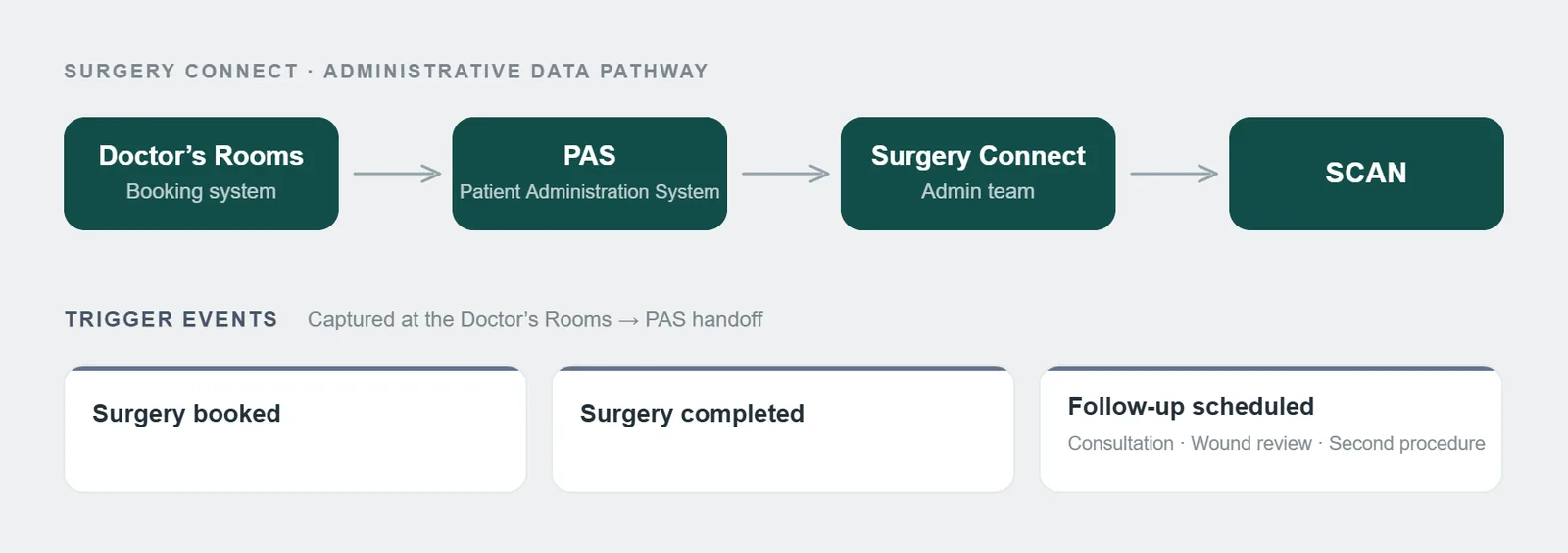
Once the treating doctor’s rooms have reviewed the referral and accepted the patient, the administrative challenge reverses direction. Information the hospital needs now originates outside the hospital, in the doctor’s rooms’ booking system, and it needs to travel back accurately and promptly.
There are three points in the patient journey where this matters most.
Surgery is booked. When the doctor’s rooms confirm a date, that booking exists in their system. It doesn’t automatically appear in your PAS. Until someone retrieves it and enters it manually, your records are incomplete, and your Surgery Connect coordinators are working from outdated information.
Surgery is completed. The treating team knows the outcome. The hospital finds out when someone follows up to ask. For a program with reporting obligations, this gap between clinical reality and administrative record is where risk accumulates.
Follow-up care is scheduled. Post-operative consultations, wound reviews, and any planned second procedures are booked through the doctor’s rooms. Without a structured handoff, those events may never make it into the PAS at all.
The pattern across all three is the same: information sits in the doctor’s rooms booking system, and someone has to manually carry it across. Automation removes that step by integrating directly with the doctor’s rooms system so that each status change (surgery booked, surgery completed, follow-up scheduled) triggers an automatic update to the PAS. Your records stay up to date without your team having to chase them.
A PAS that reliably reflects what’s actually happening is also the foundation for the next step: giving your Surgery Connect coordinators what they need to keep SCAN up to date.
3. Structured Exports for Clinical Updates
Once the Surgery Connect coordinator has current information, they still need to get it into SCAN. The submission itself is straightforward; the friction is everything that happens before it. Locating the right patient record in the PAS, identifying the specific fields SCAN requires, and formatting them correctly is manual work that sits between having the information and actually submitting it.
Automation handles that preparation. When a status change is recorded in the PAS (surgery completed, follow-up scheduled), an automated export pulls the relevant fields and structures them to match what SCAN expects. The coordinator receives something ready to submit rather than raw data they need to reformat. The judgement and the submission stay with them. The clerical work before it doesn’t.
For facilities where Surgery Connect volumes are growing, this is where time savings compound fastest. The submission frequency is high, the formatting requirements are consistent, and the task is exactly the kind of repetitive, structured work that automation handles well.
4. Clinical Credentialing
Private hospitals carry an ongoing obligation to ensure that treating doctors hold current credentials: AHPRA registration, relevant specialist society memberships such as GESA, and professional indemnity insurance. Across a pool of VMOs and visiting specialists, maintaining that current status is an ongoing administrative task.
Automation handles the tracking and follow-up reliably. Credentials approaching expiry trigger reminders to the relevant practitioner and create tasks for the credentialling team. If there’s no response within the defined window, the matter automatically escalates. Submitting updated credentials updates the record and closes the task, without anyone needing to maintain a spreadsheet or set calendar reminders.
For Surgery Connect specifically, credentialing is a compliance requirement that sits outside the referral workflow but affects every treating doctor involved in the program. Getting it off spreadsheets and into an automated system reduces risk and administrative overhead at the same time.

Where to Start
These four areas represent the most practical automation opportunities for Queensland private hospitals participating in Surgery Connect. None of them require changes to how your clinical team works. The goal is to connect the systems you already use so information moves through them automatically, rather than being carried manually between them.
Autyra works with healthcare organisations across Australia to design and implement automation solutions that integrate with existing systems and workflows. If your facility is participating in Surgery Connect and you’re feeling the weight of the administration that comes with it, we’d be glad to talk through where automation can make the most immediate difference.
Get in touch with the Autyra team